I wanted to make a history of the RCA Studio II as my second post but this will have to wait for the moment. Now some of you may wanted to mod your Studio II with composite video and audio output for quite a time now and to say "bye-bye!" to the dreaded RF switch box, well now here's your chance.
You won't need a crash course in electronics to do this i assure you as i only used a few components to do this. You will only need 1 Transistor (2N3904) and x3 Resistors (x1 4,700 (4,7K) ohms, x1 10,000 (10K) ohms and x1 1,000 (1K) ohms). See picture below:
First, you need to find the two resistors (those circled in blue) and where those two resistors are connected, you will need to do the following circuit (in red) to amplify the video signal. The two resistors just below the CDP1861 (aka Pixie) are the SYNC and VIDEO combined. After doing the circuit now is to test it if it works or not. To solder to GROUND, you can solder on the metal RF modulator as it is grounded and as for the +5 Volts, either take a multimeter and find a solder point which has the +5V or you can simply solder directly to the 9 Volts input.
If everything is OK, then this should happen:
And as you can see on the last picture, there is a switch and a Coleco Perma Power plugged in the Studio II. Those are other simple mods i added as i have thrown out the RF switch box at least a year ago. Check the pictures just how i've done it:
As you can see in the second picture, i reused the RF cable to connect the 9 Volts input jack as the cable is already isolated (and a way to recycle too!). And the last mod i did a the last minute was to install a green LED which blinks each time a sound is made (great if you muted the "BEEP" while listening to music). To do this i used the tape circuit of the Cosmac VIP and modified it as i takes a hex inverter but i used a 2N3904 (love those little transistors!) to invert the signal.
Check the video i have posted on my Youtube channel:
Now it's very late and i'm almost sleeping on the keyboard so good night folks! (RRrrZZzz....)
Thursday, January 7, 2016
Tuesday, January 5, 2016
New Blog for 2016!
Hi folks,
I have just created this new blog about anything related to the RCA Studio II like clones, games, homebrews, programmers, stories, mods, etc... ever since Blazing Lazers started a topic called "RCA Studio II GOLD MINE! An interview with the Studio 2 Production Manager!" on Atari Age (http://atariage.com/forums/topic/209519-rca-studio-ii-gold-mine-an-interview-with-the-studio-2-production-manager/), things have really moved for the Studio II and everything related and it's not about to end!
Many web sites are dubbing the RCA Studio II the "Worst Console Ever", which i find disturbing. OK the Studio II doesn't have colors, quality sounds or joysticks but it is the second cartridge-based game system ever released (the Fairchild Channel F beat the Studio II by a few weeks) and has it's place in the Video Game History (if you want the worst game system ever, just think of the Nintendo Virtual Boy...that thing gives me a headache in less than 10 minutes...i have more fun playing a Tomy 3D handheld game than playing a Virtual Boy!).
But why the RCA Studio II ? Well...first, this game system (or any clones) never was sold/released here in Canada so i only discovered that this game system existed in 1996 as i "surfed" the web for the first time. But it wasn't before meeting Al Backiel (of Digital Press) at the Phillyclassic in 2001 that i was beginning to be more interesting of this game system and the European clones, which a few weeks later i gave some information about the European clones to Al to put into the DP guide and without any warning, i was credited along Al for the RCA Studio II cartridge listing (and i also became a Guide Editor for the 6th and 7th editions thanks to Al). So since then, i still keep an eye out to any new information about the Studio II (and clones).
Back in 2007, i was thinking of modifying an RCA Studio II with 2-3 mods like Audio/Video output (done it - great to finally throw out the damn RF box!), independent power jack (also done it...sort of) and a ON/OFF switch (seems stupid but very useful which i still didn't do it). But after some time, my list of mods have grown to more than 15 mods. I will discuss those mods in time due, that's a promise!
So keep a watch from time to time in this coming year! =)
I have just created this new blog about anything related to the RCA Studio II like clones, games, homebrews, programmers, stories, mods, etc... ever since Blazing Lazers started a topic called "RCA Studio II GOLD MINE! An interview with the Studio 2 Production Manager!" on Atari Age (http://atariage.com/forums/topic/209519-rca-studio-ii-gold-mine-an-interview-with-the-studio-2-production-manager/), things have really moved for the Studio II and everything related and it's not about to end!
Many web sites are dubbing the RCA Studio II the "Worst Console Ever", which i find disturbing. OK the Studio II doesn't have colors, quality sounds or joysticks but it is the second cartridge-based game system ever released (the Fairchild Channel F beat the Studio II by a few weeks) and has it's place in the Video Game History (if you want the worst game system ever, just think of the Nintendo Virtual Boy...that thing gives me a headache in less than 10 minutes...i have more fun playing a Tomy 3D handheld game than playing a Virtual Boy!).
But why the RCA Studio II ? Well...first, this game system (or any clones) never was sold/released here in Canada so i only discovered that this game system existed in 1996 as i "surfed" the web for the first time. But it wasn't before meeting Al Backiel (of Digital Press) at the Phillyclassic in 2001 that i was beginning to be more interesting of this game system and the European clones, which a few weeks later i gave some information about the European clones to Al to put into the DP guide and without any warning, i was credited along Al for the RCA Studio II cartridge listing (and i also became a Guide Editor for the 6th and 7th editions thanks to Al). So since then, i still keep an eye out to any new information about the Studio II (and clones).
Back in 2007, i was thinking of modifying an RCA Studio II with 2-3 mods like Audio/Video output (done it - great to finally throw out the damn RF box!), independent power jack (also done it...sort of) and a ON/OFF switch (seems stupid but very useful which i still didn't do it). But after some time, my list of mods have grown to more than 15 mods. I will discuss those mods in time due, that's a promise!
So keep a watch from time to time in this coming year! =)
Friday, November 6, 2015
New Artworks for VFD games
Here's my first (and not the last) new artwork pack for MAME 0.167. The first new artwork i've done is the bezel for Coleco Pac-Man:
The second one is that i have change the color of the maze so it would look like more the arcade version (and if Coleco would have made it that way, it would have been much greater...well that's my opinion)
The third one is the only clone known of Coleco Pac-Man: the Gakken Super Puck Monster.
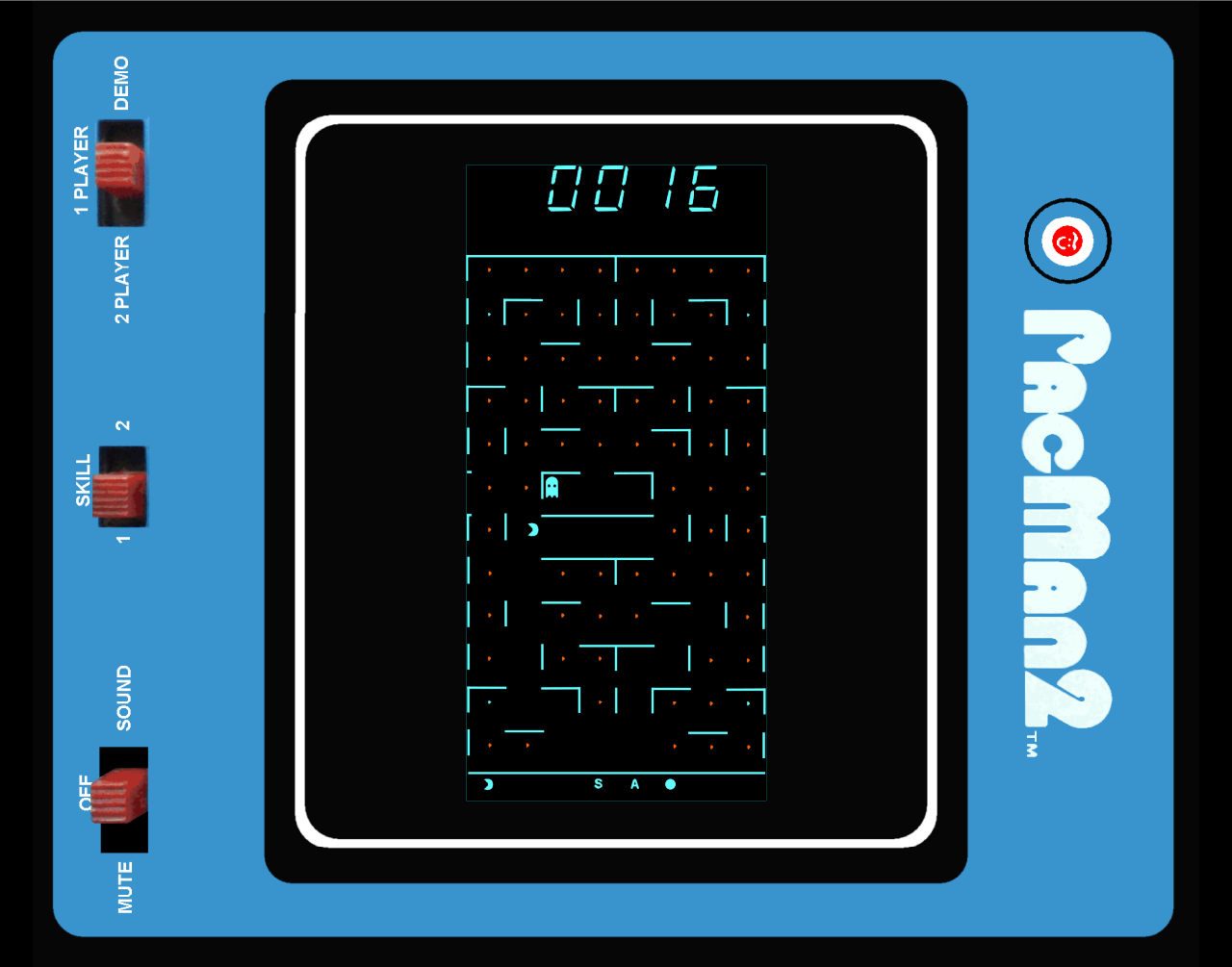
Still not enough of good old Paccy ? Then here's the bezel for Entex Pac-Man 2:
After the Entex version, i have done an artwork that was not critical but really helps when playing that game: Mattel Star Hawk (bezel with the crosshair)
and the final of the first pack (the cherry on the sunday for some of you), the bezel for Tomy Tron:
So that's it for the first new artwork pack. And here's a preview of one of the next artwork (not vectorized yet)
So try out those artworks! You can download the pack in the menu on your right (just under "downloads"). =)
--- Sly DC ---
The second one is that i have change the color of the maze so it would look like more the arcade version (and if Coleco would have made it that way, it would have been much greater...well that's my opinion)
The third one is the only clone known of Coleco Pac-Man: the Gakken Super Puck Monster.
Still not enough of good old Paccy ? Then here's the bezel for Entex Pac-Man 2:
After the Entex version, i have done an artwork that was not critical but really helps when playing that game: Mattel Star Hawk (bezel with the crosshair)
and the final of the first pack (the cherry on the sunday for some of you), the bezel for Tomy Tron:
So that's it for the first new artwork pack. And here's a preview of one of the next artwork (not vectorized yet)
So try out those artworks! You can download the pack in the menu on your right (just under "downloads"). =)
--- Sly DC ---
Thursday, November 5, 2015
What is LÖVE M.E.G.S. ?
LÖVEMEGS is a mega project which consists of simulating various electronic handheld games like the ones made by Luca Antignano (aka MADrigal - see his wonderful web site HERE). MADrigal's handheld simulators are among the most known as well as Peter Hirschberg's LEDhead which simulates many Mattel's electronic handhelds that were released in the late 70's, but they have three small problems which i find a bit irritating: small playfiled of games (we can't make them bigger or fullcreen), can't hide your desktop and finally, they work only with Windows or some old OS's. So that's why i chose LÖVE to program these handheld simulators since LÖVE can work with Windows, Mac, Linux and a few others OS's and can make any games fullscreen or not. So this project is for simulating these electronic handheld games for digital archival and historical purpose.
Now M.E.S.S. emulates many electronic handhelds games (especially VFD's and LED's) since version 0.156.
LÖVEMEGS is divided into these categories, which are:
01 - Electro-Mechanical Game [EMG] (example: Tomy Blip)
02 - Light Emitting Diode/Light Games [LED/LGT] (example: Mattel Football/MB Simon)
03 - Liquid Crystal Display Games [LCD] (example: Nintendo Game & Watches)
04 - Color LCD Games [CLG] (example: Nintendo Tabletops)
05 - Vacuum Fluorescent Display Games [VFD] (example: Coleco Arcade Tabletops)
06 - Wrist-Watch Games [WWG] (example: Nelsonic Pac-Man Watch)
Any handheld games that has a microprocessor, especially in the categories 02, 03, 04 & 05, are now on hold to see which handheld games will be added in future releases of MAME. So that leave categories 01 (EMG) and 06 (WWG) to simulate.
The biggest problem that it's "almost" impossible to simulate all the electronic handheld games out there. More than 2,000 exists and some companies continues to produce them (only VFD games aren't produced anymore, which is a real shame since they are the best ever electronic handheld games). So the best is to choose one or some games that you really love (or loved - you had one in the past) to play. If you have a problem to chose a game or need some informations about it, there is many web sites that talks about electronic handheld games but the best one i like is the "Handheld Museum" (created and maintained by Rik) web site and it also have a forum to discuss and help out about any kind of electronic handheld games.
There is also a sub-category for the EML-types that would be quite fun to add/do which are "Electro-Mechanical Toys - [EMT for short]" (an example: Nintendo Duck Hunt - 1977) that could/can be added to category #1 (Electro-Mechanical/Light Games) since these EMT-types are very close to EML-types games. Even some EMT-types are based on old "Penny Arcade" games.
Here's a list of Electro-Mechanical games i intent to simulate soon:
* Horizon/Yonezawa Screen Tennis
* Illco Magic Tennis
* Marx T.V. Tennis
* Marx T.V. Hockey
* Sears Rocket Launch (made by Alps)
* Tomy Arcade Attack (1978)/Cosmic Clash (1982)
* Tomy Arcade Racing (1978)/Daring Driver (1982)
* Tomy Blip
* Tomy Digital Derby
* Waco Electro Tic-Tac-Toe
* Waco Black Jack 21 (pocket edition)
* Waco Draw Poker (pocket edition)
* Waco Slot Machine (pocket edition)
--- Sly DC ---
Now M.E.S.S. emulates many electronic handhelds games (especially VFD's and LED's) since version 0.156.
LÖVEMEGS is divided into these categories, which are:
01 - Electro-Mechanical Game [EMG] (example: Tomy Blip)
02 - Light Emitting Diode/Light Games [LED/LGT] (example: Mattel Football/MB Simon)
03 - Liquid Crystal Display Games [LCD] (example: Nintendo Game & Watches)
04 - Color LCD Games [CLG] (example: Nintendo Tabletops)
05 - Vacuum Fluorescent Display Games [VFD] (example: Coleco Arcade Tabletops)
06 - Wrist-Watch Games [WWG] (example: Nelsonic Pac-Man Watch)
Any handheld games that has a microprocessor, especially in the categories 02, 03, 04 & 05, are now on hold to see which handheld games will be added in future releases of MAME. So that leave categories 01 (EMG) and 06 (WWG) to simulate.
The biggest problem that it's "almost" impossible to simulate all the electronic handheld games out there. More than 2,000 exists and some companies continues to produce them (only VFD games aren't produced anymore, which is a real shame since they are the best ever electronic handheld games). So the best is to choose one or some games that you really love (or loved - you had one in the past) to play. If you have a problem to chose a game or need some informations about it, there is many web sites that talks about electronic handheld games but the best one i like is the "Handheld Museum" (created and maintained by Rik) web site and it also have a forum to discuss and help out about any kind of electronic handheld games.
There is also a sub-category for the EML-types that would be quite fun to add/do which are "Electro-Mechanical Toys - [EMT for short]" (an example: Nintendo Duck Hunt - 1977) that could/can be added to category #1 (Electro-Mechanical/Light Games) since these EMT-types are very close to EML-types games. Even some EMT-types are based on old "Penny Arcade" games.
Here's a list of Electro-Mechanical games i intent to simulate soon:
* Horizon/Yonezawa Screen Tennis
* Illco Magic Tennis
* Marx T.V. Tennis
* Marx T.V. Hockey
* Sears Rocket Launch (made by Alps)
* Tomy Arcade Attack (1978)/Cosmic Clash (1982)
* Tomy Arcade Racing (1978)/Daring Driver (1982)
* Tomy Blip
* Tomy Digital Derby
* Waco Electro Tic-Tac-Toe
* Waco Black Jack 21 (pocket edition)
* Waco Draw Poker (pocket edition)
* Waco Slot Machine (pocket edition)
--- Sly DC ---
Hanimex HMG-7900 cartridge PCB scans
I'm still trying to retrace all the pins of the D779C-300 so when it will be finished, i will post the pinouts and infos. But in the meantime, here's some scans of the cartridges i have so far:
I will lend these carts to plgDavid so that he will make dumps to preserve them and to see the Soundic SD-200/Hanimex HMG-7900 emulated one day. =)
--- Sly DC ---
SD-201 (front)
SD-201 (back)
SD-202 (front)
SD-202 (back)
SD-203 (front)
SD-203 (back)
SD-205 (back)
SD-205 (front)
As you can see, the SD-201 (aka Chaser/Gobeur) doesn't have any ROM, only a PCB with some jumpers to activate the Chaser/Gobeur game which reside in the D779C-300. So when another cartridge is connected, it shuts-off the Chaser/Gobeur game and the ROM replaces the Chaser/Gobeur game.
SD-202 (Space Smash) and SD-203 (Saucer Attack) have the same PCB's and connections, the only difference between the two is the model number of the ROM which are made by Motorola: SC87027P (SD-202) and SC94806P (SD-203).
The SD-205 (breakaway) PCB has also the same connections BUT it has a CD4069, two diodes and three resistors as extra components. Since i don't have all the other cartridges, i can't say what is it truly used for as i didn't retrace the PCB, but it looks like (just guessing here) that it is for the paddle as it is the only game that uses the paddle. Will know for sure when i have retrace it. ;)
I tried to find information about the Motorola ROM(or Masked ROM as plgDavid suggested since he told me that many time masked ROMs doesn't have any specific indications) but i only found that some companies has still has some of the Motorola ROMs in stock so no datasheets or extra information (so far). But what bugs me is that the smallest EPROM that has 28-pins is an 2764 (and compatible) which can contain up to 8K, but seeing how the games are very blocky and simple, i would estimate that the games are 1 or 2K in size.
I will lend these carts to plgDavid so that he will make dumps to preserve them and to see the Soundic SD-200/Hanimex HMG-7900 emulated one day. =)
--- Sly DC ---
Thursday, October 29, 2015
Hanimex HMG-7900
I've been asked if i had information about the Hanimex HMG-7900, the games and the clones. Well in fact i do, i even wanted to write a FAQ about it. This would be the successor of the Epoch Cassette Vision since both game systems are pretty similar in hardware and software but not exactly the same.
First, it is really the Soundic Soundvision SD-200 that is the "parent" and all the others are clones. Yes, the Hanimex HMG-7900 is in fact a clone but it is the most popular known compared to the Soundic Soundvision SD-200. There is three types of models: the SD-200, the SD-270 and the SD-290 but all have the same main chip: a NEC uPD779C-300. The D779C is very similar to the chips inside the ECV cartridges but there is a major difference, the D779C is programmable compared to the D774C, D777C and D778C.
The D779C has the game "Chaser" programmed inside it but can be switched-off and be replaced by an external PROM/ROM. Before i go into technical details, here's the list of all the clones:
Company & Name of game system // Released // Year
===================================================
* Soundic Soundvision SD-200 // Europe // 1983
===================================================
* Eltron Programmable Color Video Game SD-200 // Hungary // 1984
* Hanimex HMG-7900 (SD-200) // France // 1983
* ITMC Programmable Color Video Game SD-290 // France // 1983
* JouéClub Programmable Color Video Game SD-290 // France // 1983
* Ormatu Video Spelcomputer 1001 (SD-290) // Netherlands // 1983
* Rollet Videocolor SD-270 // France // 1983
* Soundic Programmable Color Video Game SD-290 // Europe // 1983
* Zodiac (??) (SD-200) // Finland // 1983
The last one " Zodiac" is mentioned on the web site "NES-Retromaailma" (http://www.nesretro.com/database/listat/muut.php?id=67) but there is no full name or picture(s) of the game system.
As for the games, there is 9, not 10 that were officially released. Game manuals have been found it four different languages so here's the list i have so far: (Note: Model can be either SD-20x or PC-20x)
Model // English // French // Italian // Hungarian
============================================
* SD-201 // Chaser // Gobeur // L'Inseguimento // Labirintus
* SD-202 // Space Smash // Meteorites // Space Smash // ???
* SD-203 // Saucer Attack // Envahisseurs // ??? // Urtamadas
* SD-204 // Raging Turtle // Course à la Tortue // ??? // ???
* SD-205 // Breakaway // Mur de Briques // ??? // ???
* SD-206 // Martian // Martian // Marziani // ???
* SD-207 // Outworlder // La Rivière Sauvage // ??? // ???
* SD-208 // Expedition // Trésor du Pharaon // ??? // Expedicio
* SD-210 // Space Scout // Les Aventuriers de L'Espace // ??? // Orjarat Az Urben
Unreleased Games (known so far):
============================================
* SD-209 // Fire Attack // Le Chevalier du Feu (1-player game)
* SD-2?? // Ice Skating (1or2-players game)
* SD-2?? // Road Race (1or2-players game)
* SD-2?? // Ski (1or2-players game)
* SD-2?? // Soccer (1or2-players game)
* SD-2?? // Tennis (1or2-players game)
Credits goes to Olivier Boisseau (of Old-Computers.com) that he was the first one to notice that the Hanimex HMG-7900 and the Epoch Cassette Vision looked very similar graphically. Check out his report HERE.
Here's a blown-up and rendered screenshot of the "SD-209: Fire Attack"
And if you want to see some videos, go check HERE
I don't have the game system manual in English, only in French but at least, i have the "Chaser" game manual in plain English:
And here's a few cartridge scans:
Up in the next post, technical details and pictures of some cartridges and game systems. :)
--- Sly DC ---
First, it is really the Soundic Soundvision SD-200 that is the "parent" and all the others are clones. Yes, the Hanimex HMG-7900 is in fact a clone but it is the most popular known compared to the Soundic Soundvision SD-200. There is three types of models: the SD-200, the SD-270 and the SD-290 but all have the same main chip: a NEC uPD779C-300. The D779C is very similar to the chips inside the ECV cartridges but there is a major difference, the D779C is programmable compared to the D774C, D777C and D778C.
The D779C has the game "Chaser" programmed inside it but can be switched-off and be replaced by an external PROM/ROM. Before i go into technical details, here's the list of all the clones:
Company & Name of game system // Released // Year
===================================================
* Soundic Soundvision SD-200 // Europe // 1983
===================================================
* Eltron Programmable Color Video Game SD-200 // Hungary // 1984
* Hanimex HMG-7900 (SD-200) // France // 1983
* ITMC Programmable Color Video Game SD-290 // France // 1983
* JouéClub Programmable Color Video Game SD-290 // France // 1983
* Ormatu Video Spelcomputer 1001 (SD-290) // Netherlands // 1983
* Rollet Videocolor SD-270 // France // 1983
* Soundic Programmable Color Video Game SD-290 // Europe // 1983
* Zodiac (??) (SD-200) // Finland // 1983
The last one " Zodiac" is mentioned on the web site "NES-Retromaailma" (http://www.nesretro.com/database/listat/muut.php?id=67) but there is no full name or picture(s) of the game system.
As for the games, there is 9, not 10 that were officially released. Game manuals have been found it four different languages so here's the list i have so far: (Note: Model can be either SD-20x or PC-20x)
Model // English // French // Italian // Hungarian
============================================
* SD-201 // Chaser // Gobeur // L'Inseguimento // Labirintus
* SD-202 // Space Smash // Meteorites // Space Smash // ???
* SD-203 // Saucer Attack // Envahisseurs // ??? // Urtamadas
* SD-204 // Raging Turtle // Course à la Tortue // ??? // ???
* SD-205 // Breakaway // Mur de Briques // ??? // ???
* SD-206 // Martian // Martian // Marziani // ???
* SD-207 // Outworlder // La Rivière Sauvage // ??? // ???
* SD-208 // Expedition // Trésor du Pharaon // ??? // Expedicio
* SD-210 // Space Scout // Les Aventuriers de L'Espace // ??? // Orjarat Az Urben
Unreleased Games (known so far):
============================================
* SD-209 // Fire Attack // Le Chevalier du Feu (1-player game)
* SD-2?? // Ice Skating (1or2-players game)
* SD-2?? // Road Race (1or2-players game)
* SD-2?? // Ski (1or2-players game)
* SD-2?? // Soccer (1or2-players game)
* SD-2?? // Tennis (1or2-players game)
Credits goes to Olivier Boisseau (of Old-Computers.com) that he was the first one to notice that the Hanimex HMG-7900 and the Epoch Cassette Vision looked very similar graphically. Check out his report HERE.
Here's a blown-up and rendered screenshot of the "SD-209: Fire Attack"
This a Donkey Kong-type game clone.
And if you want to see some videos, go check HERE
I don't have the game system manual in English, only in French but at least, i have the "Chaser" game manual in plain English:
And here's a few cartridge scans:
Up in the next post, technical details and pictures of some cartridges and game systems. :)
--- Sly DC ---
Wednesday, October 21, 2015
Pictures of cartridge #1 to 9 PCB's
It may sound silly to see all the PCB's of each games but information is never silly, in fact knowledge is power..ok you won't lift a car..it is mind power that i'm talking about. As i was taking pictures of the PCB's, i notice that some uses the same (or almost) layouts while others has more components (like Baseball).
I'll post the picture of the PCB's by cartridge number order (from 1 to 9):
Yosaku PCB front
Yosaku PCB back
Baseball PCB front
Baseball PCB back
Galaxian PCB front
Galaxian PCB back
Big Sports 12 PCB front
Big Sports 12 PCB back
Battle Vader PCB front
Battle Vader PCB back
Pakpak Monster PCB front
Pakpak Monster PCB back
New Baseball PCB front
New Baseball PCB back
Monster Mansion PCB front
Monster Mansion PCB back
Astro Command PCB front
Astro Command PCB back
Sorry if some pictures are not aligned/displaying correctly, but in my computer they are all OK. So that's it for today since i have neglected the OdySim blog for a couple of days, it's because that the OdySim is....NAH!! I'm not telling here...go read the OdySim blog in the following 24 hours, you'll have a "驚き". =)
--- Sly DC ---
Subscribe to:
Comments (Atom)